
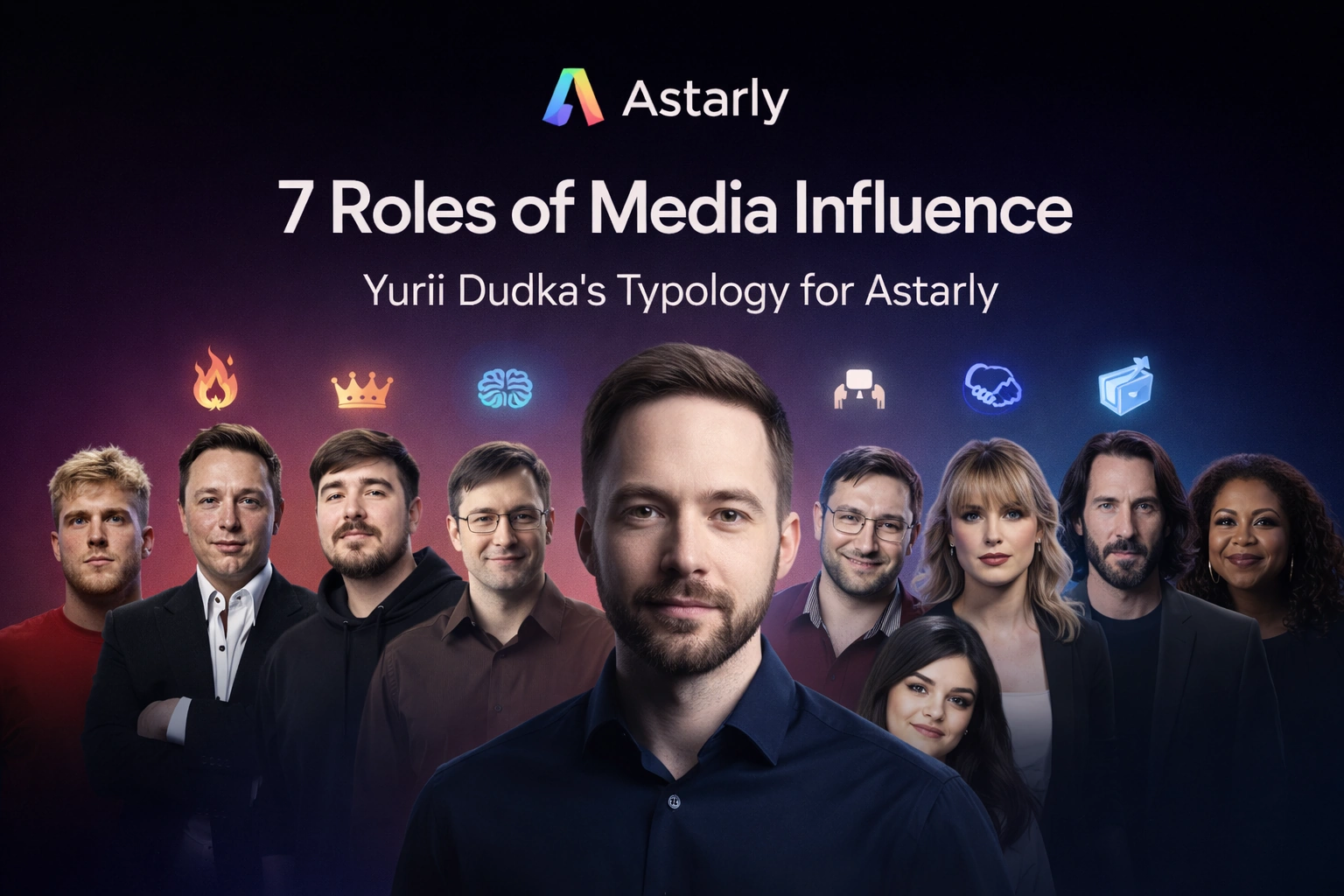
In media, the winner is not always the loudest person, the most conventionally attractive person, or even the smartest one. More often, the advantage goes to the person whose presence is understood instantly. In just a few seconds, the audience senses who is in front of them: someone who hits hard, calmly leads, explains with clarity, entertains at high speed, or slowly pulls everyone into their field.
That is exactly the logic behind Yurii Dudka’s media influence typology in Astarly. It is not academic psychology. It is a practical model that helps people understand how they influence attention, trust, and perception in public space.
This matters especially for hosts, experts, creators, and anyone building a personal brand through voice and presence. That is also why the TV Hosting course is relevant far beyond television itself: it helps people understand not only how to speak, but how they are perceived on camera.
1. Provocateur
The Provocateur works through impact. This type breaks expectations, sharpens the message, creates tension, and sometimes even irritates people on purpose. But that is exactly why the Provocateur is so hard to ignore. It is not necessary for this role to be loved. It is necessary to trigger a reaction.
The strength of this role is conflict, edge, and the ability to seize attention immediately. A strong modern example is Jake Paul. His media force is built in large part on deliberate provocation. Piers Morgan fits this logic too: he holds attention through friction, confrontation, and sharp public angles.
2. Charismatic Leader
The Charismatic Leader influences differently. This person does not need constant spectacle or volume. Their power comes from inner direction. They sound like someone who already knows where to go. There is confidence, structure, and a feeling of gravity in the way they speak.
People want to follow this type because the Charismatic Leader feels grounded. A classic example is Steve Jobs, not only because of his scale, but because of his ability to define direction and make others believe in a vision. A softer modern example is Simon Sinek, whose influence comes from calm conviction, clarity of thought, and leadership framing.
3. Logical Expert
The Logical Expert is not just “a smart person.” This is someone who can make complex things understandable. Their strength is not status pressure, but clarity. After listening to them, the audience feels relief: “Now I finally get it.”
This type explains, structures, simplifies, and removes chaos. That is why it creates both trust and respect. Andrew Huberman is a strong example because his delivery is built on translating difficult subjects into clear, usable language. Neil deGrasse Tyson also fits well here because he turns complexity into something human and engaging.
For people who want to speak clearly and build authority in public, this principle is deeply connected to media training. In the Astarly TV Hosting program, strong delivery is not treated as decoration. It is part of how expertise becomes convincing on camera.
4. Energetic Showman
The Energetic Showman holds attention through tempo, emotion, and constant movement. This type amplifies everything: the rhythm, the delivery, the scale, the sensation of event. Their role is not only to communicate a point, but to make the audience feel something dynamic while receiving it.
This is the type that refuses to let attention cool down. MrBeast is nearly a perfect example because his influence is built on spectacle, energy, escalation, and retention. For range, Beyoncé also fits as an example of someone who commands attention through energy, stage force, and total control of delivery.
5. Cold Control
Cold Control is one of the strongest and most distant media roles. Usually, this is a very intelligent, highly contained, and emotionally detached person who creates the impression that everyone around them is slower, weaker, or less capable. That may not literally be what they think, but their delivery creates exactly that effect.
There is little warmth here, little need to please, and very little emotional softness. Instead, there is dry power, restraint, and a sense of superiority. Elon Musk fits this type well because his public presence often carries a hard engineering distance and very little emotional cushioning. A quieter version of the same pattern can be seen in Mark Zuckerberg, whose media style also feels highly detached, rational, and almost indifferent to warmth.
6. One of Us
One of Us, or “someone familiar,” is the opposite of cold distance. This person does not perform untouchability, does not push status, and does not try to stand above the audience. They sound simple, warm, and accessible, which quickly creates the feeling: “I know this person,” “she feels real,” or “he feels safe.”
This is a very powerful form of influence because people attach not only to scale, but to closeness. Taylor Swift and Selena Gomez are strong examples. Both are major public figures, yet both still carry a quality of emotional familiarity and human accessibility in their image.
This role matters a lot for creators, interviewers, and public-facing experts. Very often, trust grows not from perfection, but from the feeling that the person on screen is understandable and real. That is why media growth today often depends not only on content, but on whether the audience feels connected to the person delivering it. This is one more reason the course structure matters for modern creators, not only for future TV presenters.
7. Magnetic
The Magnetic role is special in Yurii Dudka’s typology. This is calm depth. The Magnetic type does not shout, does not chase attention, and does not try to win people aggressively. They do the opposite: they speak slowly, hold pauses, and do not adapt to someone else’s pace. Instead, they gradually impose their own rhythm on the room.
This role works almost like a python: no sharp movements, no hysteria, no visible struggle for dominance, yet little by little all attention moves toward them. This is influence through presence, inner weight, and slowness that feels stronger than noise.
Oprah Winfrey is a very precise example because she knows how to hold a space until the whole conversation begins to move at her pace. A quieter and almost silent version of the same effect can be seen in Keanu Reeves, who carries very little noise and very little forceful performance, but a great deal of gravity and attraction.
Why this matters for media growth
For a blogger, expert, entrepreneur, host, or author, this changes everything. Once a person understands their media mechanism, they stop copying other people’s roles and become more coherent. Their delivery becomes cleaner. Their image becomes stronger. Their public style starts feeling natural instead of borrowed.
And that is where recognition, trust, and real media power begin to grow. If you want to develop that kind of delivery in practice, start with the TV Hosting course and build your public presence with more awareness and control.